Skip to content

What is The Truth about KC Johnson?

I’ve already written twice about this episode of the Duke lacrosse scandal. Check the first of those posts for details. I touched on it again to make some points about people jumping to conclusions in a heated controversy that’s bound to have some nastiness on both sides. But there was an important piece of the puzzle that I didn’t see until after I posted, and now I’m feeling like I went a little overboard with the fair and balanced routine. I should have learned by now not to underestimate KC Johnson’s willingness to cook up the “facts” he needs for his Durham-in-Wonderland crusade.

Here’s the tale. It’s late October 2006. The indicted lacrosse players have recently been on 60 Minutes, and the election that will decide if Nifong will continue as DA is a couple of weeks away. Duke Chemistry professor Steven Baldwin writes an editorial in the Duke Chronicle calling the administration and a portion of the faculty to account for their abysmal record during the scandal. He’s defiant and forthright in the face of the rush-to-judgment crowd’s choke-hold on campus, declaring that some of his colleagues “should be tarred and feathered, ridden out of town on a rail and removed from the academy.” He was simply insisting that professors do their duty and treat their students decently, but

[his] missive did arouse the wrath of the righteous. Ignoring any pretense of desiring dialogue and debate with those who dared to challenge their agenda, the Group [of 88] and its sympathizers immediately tried to silence Baldwin. “Clarifying” faculty Robyn Wiegman wrote a letter to the Chronicle bizarrely suggesting that Baldwin’s op-ed used the “language of lynching,” only to receive a history lesson from Johnsville News. Baldwin, undeterred, continued speaking up for all Duke students throughout the spring.

Weigman and others “proceeded to torment the professor who showed the moral courage” to demand accountability from his colleagues. One colleague even emailed Baldwin with “an implicit call for violence.” And the torment had its “unbearably sad” effect.

Professor Baldwin, having used a perfectly apt metaphor for how the unapologetic faculty members should be treated, then saw fit to kneel down at the altar of political correctness and issue the ritual apology.

That’s the operatic version of reality you’ll get from KC Johnson and Harvey Silverglate, co-founder of the Foundation for Individual Rights in Education. Silverglate, in particular, can really lay it on with a trowel. Here, though, is the email from political science professor Kerry Haynie that, as Johnson and/or Baldwin see it, includes an “implicit call for violence.” Continue reading ›

Tagged , , , , ,

Rhetorical thuggery

This post about the Duke lacrosse case is the last of three parts about how KC Johnson produced his cast of extremists—you can go back to the introduction or the part about Karla Holloway.

Most of Mark Anthony Neal’s (disclaimer) appearances in Durham-in-Wonderland (DIW) are pinned to one of three things. The first is his appearance at the April 2006 Conversation on Campus Culture. The second is an article he posted on his blog about the lacrosse case, and the third is an interview that Duke’s alumni magazine ran in the summer of 2006. The two texts each yield one really useful nugget of evidence, and the rest is incidental. In the article it’s the paragraph about how the team was “hoping to consume something that they felt that a black woman uniquely possessed.” In the interview it’s the exchange where Neal talks about the “hard-core intellectual thuggery” of his “alter ego… thugniggerintellectual.” It’s perfectly fair for Johnson to single those two passages out, but it matters what’s left out. Since he reads the “listening” statement as an announcement from Neal and the other 87 who signed it that some lacrosse players were guilty of rape, a little attention needed to be paid to Neal’s forthright statement in the second paragraph of the article that “[t]he results of a DNA analysis taken after the alleged attack suggest that the members of the Duke lacrosse team were not involved in the attack.” Then there’s the rest of the article (the bulk of it doesn’t related directly to the lacrosse team), the less outrageous parts of the interview, and the rest of Neal’s published writings—all potentially relevant since Johnson is prosecuting Neal on the basis of his character and beliefs.

I don’t think any single word has been as useful to Johnson as the one Neal handed to him on a platter. Continue reading ›

Tagged , , ,

The making of an anti-lacrosse extremist

This post about the Duke lacrosse case is the second of three parts about how KC Johnson produced his cast of extremists—you can go back to the introduction or skip ahead to the part about Mark Anthony Neal.

Karla Holloway (disclaimer) is one of the “listening” statement endorsers with the highest profile on Durham-in-Wonderland (DIW). Neal is in the next tier down but still among the dozen or so that crop up most often. Like the rest of the endorsers, Johnson presumes both of them guilty of having presumed and announced the lacrosse players’ guilt. Beyond that, whatever incriminating evidence he can pin on individual endorsers is icing on the cake, and with repetition he has no trouble making a little bit go a long way. Relatively speaking he comes up with a lot to hold against Holloway, but the centerpiece is the article entitled “Coda: Bodies of Evidence” that she wrote for the Summer 2006 issue of The Scholar and Feminist Online. I’ll concentrate on that article and its tie-in with her service on the Campus Culture Initiative (CCI), along with Johnson’s response. If you’re interested you can find her rap sheet in this DIW post.

“Bodies of Evidence” is not a general-purpose analysis of the case or a full-scale rationalization of her positions on it, it’s personal impressions and commentary that relate the lacrosse case to the theme of the issue (“The Cultural Value of Sport: Title IX and Beyond”), pitched to the interests of the journal’s readers. Holloway is a veteran academic administrator and naturally seems to see things from an institutional perspective. She frames the schools response to the lacrosse case as a clash between the institution’s dedication to athletics and its commitment to race and gender equity. In parts of the article she’s effectively thinking out loud about how athletics seem to have trumped equity. Two questions represent her disillusionment with both sides. On one hand, if students behave atrociously, what does it matter if they’re national-class athletes with good grades? On the other hand, if the university accepts that women and minorities are disadvantaged, why does it expect them to take on the extra work of documenting the inequity and figuring out how to address it? The two meet head-to-head because of the university’s sense that she should put her body in the line of rhetorical fire serving on a committee charged with patching up the mess.

At every level, starting with the premises, the article is full of assumptions, claims and observations that are eminently debatable—both questionable and the basis for a worthwhile debate. It also offers a candid view of the mechanics of a diversity-minded institution through the eyes of a consummate insider. Johnson shows no interest in either debate or insight. Instead he reworks the text, making it the product of the extremist he knows Holloway to be so he can demolish it.

Continue reading ›

Tagged , , ,

KC Johnson and the extremist factory

After a very long break, I’m picking up where I left off in my analysis of the Duke lacrosse case, still concentrating on the role Durham-in-Wonderland (DIW) played in framing and setting the tone of the debate about academic culture at Duke. This time I’m turning from KC Johnson’s criticism of the Duke faculty who endorsed the “listening” statement, taken as a whole (the so-called “Group of 88”), to his criticism of two professors from the group—Mark Anthony Neal and Karla Holloway. Turning from group to individual, the reflexes I’ve already pointed out of a cutthroat prosecutor dead set on securing the conviction are even clearer. My little project has snowballed as I’ve added bits and pieces over the past few months, gotten fed up and set it aside, pulled it out and added a little more, etc. What’s made it interesting enough to finally pull together into something more or less readable is the view it gives of the inner workings of a parallel reality—a product of language that’s quite convincing on its own terms but deeply deceptive. Johnson hit the nail on the head when he set it in Wonderland.

Continue reading ›

Tagged , , , , , ,

Sense and nonsense from the legal department

In the last couple of days I came across this odd juxtaposition of legal perspectives that speak to KC Johnson’s treatment of the lacrosse case.

The sense is a blog entry by University of Texas law professor Brian Leiter taking KC Johnson to task for his lacrosse-case coverage. In Leiter’s opinion “KC Johnson doesn’t read too well, and like most misreaders with an agenda, he misreads with a vengeance.” The two key texts for which Leiter disputes Johnson’s readings are the “listening” ad—Leiter has the chutzpah to argue that the ad’s endorsers actually know their own minds when they claim that the ad does not judge the lacrosse players guilty—and Wahneema Lubiano’s email soliciting signatures, in which, he argues, her mention that the ad is “about the lacrosse team incident” can’t be read as a statement of purpose that overrides what’s said in the ad itself.

I particularly appreciate his concluding paragraph:

Neither lawyers nor one expects historians would ordinarily credit such tortured interpretive practices as those Professor Johnson brings to bear in order to smear a “group” of faculty. That he overreached in this regard is all the more regrettable since it is clear that there were some individual faculty who made comments (that have no resonance with the ad) that were, at best, intemperate and, at worst, grossly irresponsible.

The “Group of 88” is not a help but a hindrance to anyone who wants to understand what went wrong at Duke in spring 2006.

The nonsense is an article by Azhar Majeed entitled “More Shameful Behavior at Duke University” in the webzine of an organization called the FIRE (“Foundation for Individual Rights in Education”). Continue reading ›

Tagged , , ,

KC Johnson: the other Duke Lacrosse prosecutor

This is the fourth in a series of posts looking at the crusades mounted on both sides of the Duke lacrosse case. The first has an introduction and overview. The second and third are about the potbanging protest and its connection to and impact on the controversy surrounding the “listening” statement. This one turns to the other side of the coin—KC Johnson and his blog Durham-in-Wonderland (DIW).

DIW has its virtues. Johnson has a remarkable ability to synthesize information coming in from all sides and quickly turn it into cogent text. And what he writes about is well documented and well linked, so the blog is a tremendous resource for anyone interested in tracking down a document, an event, or a quote from this or that phase of the scandal. Gathering and organizing all the detail and technicality of a legal proceeding is something he seems well suited for, and as far as I can tell his coverage of Nifong and the judicial and law enforcement aspects of the case is thorough and accurate. He’s thanked personally in the statements Reade Seligmann and Collin Finnerty made when they were exonerated—something he can justly be proud of.

Roughly half of the blog [correction: roughly a quarter] is devoted to the way the case played out at Duke, and there is, in my opinion, much less to be proud of on that side. Under his blog title, Johnson promises “comments and analysis about the Duke/Nifong case.” No matter what aspect of the case he’s writing about, though, he approaches it more as a prosecutor than an analyst (at times inquisitor is probably more apt). An analyst explains and explores and maybe even illuminates, if you’re lucky. Prosecution is by comparison much more focussed, selective, and agenda-driven. While the job of a criminal prosecutor is to build a case against the defendant(s), as I understand it his ultimate goal is not supposed to be conviction but the correct verdict. The big villain of the lacrosse case was a prosecutor who cared about nothing but the conviction. Johnson has prosecuted the so-called “Group of 88” Duke faculty in the court of public opinion with a similarly narrow and self-serving commitment to doing what it takes to get that guilty verdict, and he’s proven to be much better at it than Nifong. Given all the scorn he heaped on the now-disgraced criminal prosecutor, with good reason—for ignoring exculpatory evidence, manipulating public opinion and various other shoddy maneuvers—you’d think Johnson would be more principled in taking on his own chosen wrongdoers. If he is, it’s not by much.

That’s not to say that there’s any ethical equivalence—Nifong betrayed the trust he held as a public servant, and if he had been successful the consequences would have been catastrophic for the people effected. Even his failed prosecution turned lives upside down. The worst Johnson can do to any individual is trivial by comparison, but he still has enough influence on opinion and discussion of the case to do widespread damage. Continue reading ›

Tagged , , , ,

Responses to KC Johnson and others (revised)

I left out a few things when I hastily posted this earlier today, so this is version 2…

I’ve been hoping to finish a full-blown post with the evidence Johnson was wondered so much about. As usual, things drag on. So, as a stopgap, some responses to Johnson and other commenters. [A “full-blown post” is now available.]

Continue reading ›

Tagged , ,

The exchange with Dr. Johnson

This is my email exchange with KC Johnson before he posted in answer to my first three posts in my Duke Lacrosse case series. References to Claire Potter are explained, more or less, in this entry and the entries it links to.

[Dec. 11: I originally posted only paraphrases of Johnson’s emails to me but have replaced them with his full text. Here is the first post backing up the claims I made about DIW.]


~ ~ ~

From: KC Johnson
Date: November 29, 2007 7:16:49 AM EST

Professor Zimmerman:

I noticed your two recent blog postings on the lacrosse case.

I was particuarly struck by your statement about “efforts when the ad was written to make much different points in a much different way than the protestors.” As far as I could tell, that statement constituted the only specific evidence you supplied to justify your assertion that I had engaged in “insidiously polarizing,” “irrational,” and “anti-intellectual” behavior—strong charges, indeed, against a fellow academic.

I therefore was—and remain—surprised that you did not cite or provide a link to evidence to describe these heretofore unrevealed “efforts when the ad was written to make much different points in a much different way than the protestors.” I plan to write on the issue Monday; before doing so, I wanted to ask if you could point me to the clause in the Group of 88’s statement in which the signatories made “efforts when the ad was written to make much different points in a much different way than the protestors,” especially given that the ad said “thank you for not waiting and for making yourselves heard” to the “protesters making collective noise.” Failing that, I wonder if you could point me to a statement in which even one member of the Group has publicly criticized the “castrate” banner or the potbangers’ protest.

By the way, I commend you for deeming the banner inappropriate. If only more Duke faculty members shared your courage in criticizing the potbangers, perhaps even by speaking out immediately after the protest occurred—

KC Johnson

Continue reading ›

Tagged , ,

A perfect mess

This is the third in a series of posts looking at the crusades mounted on both sides of the Duke lacrosse case. The first for an introduction and overview. This post continues directly from the previous one about the potbanging protest held at the lacrosse team captains’ house soon after the rape allegation became public. There I looked at an interview with one of the organizers, Manju Rajendran, and an essay by Brian Proffitt, another activist.

Proffitt’s simplifying frame tends to reduce accuser and accused to archetypes—Rapist and Survivor. Another level of abstraction is close at hand, though, in his list of discriminations that rape survivors are leading the resistance to (“violence, homophobia, transphobia, racism, sexism, and capitalism”) and Rajendran’s sweeping claim to be calling the lacrosse team to account for “the racism and the sexism and the classism” of what they did. Rapist and Survivor become Oppressor and Oppressed. In an essay “Perfect Offenders, Perfect Victim: The Limitations of Spectacularity in the Aftermath of the Lacrosse Team Incident”, posted a month after the lacrosse party, Wahneema Lubiano, a professor in Duke’s Department of African and African American Studies, critiques the habit of “perfecting” the protagonists so that the role of oppression or prejudice in an incident is blatantly obvious and therefore “spectacular.” The inevitable resistance sets up a polarizing dynamic:

I hear desire on the part of various constituencies for the comfort either of being able to construct a perfect offender and a perfect victim, and, therefore, some kind of resolution, or the converse position—the comfort of saying that the impossibility of constructing a perfect offender and a perfect victim means that nothing happened and that nothing needs to be resolved.

Lubiano urges like-minded activists responding to the lacrosse case to get off this treadmill, since it causes “[w]hatever is routine about this incident [to be] marginalized while a desire for the incident to live up to its most horrific possibilities fights it out in public discussion with its rhetorical other….” A good description, I think, of the lacrosse-case version of a culture-war shouting match, and her description of the dynamic as a “desire… for comfort” is apt. Continue reading ›

Tagged , , , , , ,

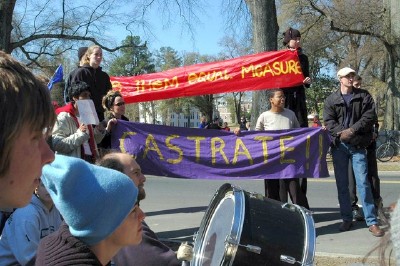
The trouble with potbanging

This is the second in a series of posts looking at the crusades mounted on both sides of the Duke lacrosse case, in the hope of shedding some light on the way they’ve overshadowed meaningful debate about the incident and its aftermath. You can click back to the first post for an introduction and overview. Here I’ll take on the potbanging protest—the rally on Sunday morning, March 26, 2006 at the scene of the party that led to the rape allegation. I’m writing, I think, mostly for people who are inclined to approve of or rationalize this protest as uncompromising and forceful advocacy and the speaking of truth to power. That was more or less my first impression as I ran across references to it in articles and discussions about the case (this was months after they happened for reasons I explain in my introduction). My reaction was probably defensive as much as anything else, because what I came across first, mostly, was dismissive or derisive comments from liestoppers—those on and similar web forums who see the case only in terms of the injustice done to the lacrosse team. That kind of defensiveness is all too typical of polarized debates like this one and all it does is perpetuate and accentuate the divisiveness. After taking a closer look, I believe this protest was ill-conceived and self-defeating. It’s a shame that those who have pushed for a broad discussion of social or gender or racial equity have let the issues raised by this and similar protests fester.

How did protesters espousing an end to not only sexual violence but all violence convince themselves that it was a good idea to stand in front of the lacrosse players’ house on Buchanan Blvd. with a banner screaming “Castrate!!”? Even given the rally’s aim of confronting the lacrosse team to get them to talk, it’s hard to see what purpose such a vile but empty threat could serve, and also hard to imagine that no one involved realized how much it made them look like hypocritical, bloodthirsty zealots. Of course that’s all ridiculously easy to point out in retrospect. I don’t at all discount the genuine concern for victims of sexual assault—a terrible, debilitating crime—that motivated most if not all the protestors. I expect that some of the outrage came from brutally real personal experience of assault, something that far too many women have to live with. I can only go on what I can see and read, though, and in that the action is represented not only as a denunciation of the team but also righteous support for the woman alleging rape and for other assault survivors. The “Castrate” banner, which was likely the work of only a few of those present but was apparently tolerated all around, shows how much the action was ultimately defined by what was opposed rather than what was supported.

Continue reading ›

Tagged , , , ,